Last Updated: October 30, 2026
Quick Summary
The signs of faulty house wiring include a circuit breaker that keeps tripping, flickering or dimming lights, burning smells near sockets, sparking sockets and crackling sounds, warm switch plates, scorch marks, frayed cables and buzzing from the consumer unit. A burning smell or continued sparking is an emergency: isolate the circuit and call an electrician immediately.
- Never tape a breaker in the on position or fit a higher-rated device to stop it tripping.
- A burning smell near a socket or switch is the most urgent sign on the list.
- Crackling at a socket usually means electrical arcing behind the socket face.
- Switch plates should feel cool, so a warm socket with nothing plugged in is a fault.
- Wiring dating from the 1970s or earlier that has never been updated likely needs rewiring.
Table of Contents
- Why Faulty Wiring Deserves Your Full Attention
- 8 Warning Signs of Faulty House Wiring
- 1. A Circuit Breaker That Keeps Tripping
- 2. Flickering or Dimming Lights
- 3. Burning Smells Near Sockets or Switches
- 4. Sparking Sockets and Crackling Sounds
- 5. Warm or Hot Sockets and Switch Plates
- 6. Discolouration, Scorch Marks or Visible Damage
- 7. Frayed, Exposed or Damaged Wiring
- 8. Buzzing Sounds From Switches or the Consumer Unit
- When a Circuit Breaker Keeps Tripping: Fault or Normal?
- Signs Your Home Needs Rewiring Rather Than a Repair
- What to Do If You Suspect Faulty Wiring
- Booking an Electrical Safety Inspection for a Home
- Request a Wiring Assessment From MDS Electrical
- Frequently Asked Questions
Why Faulty Wiring Deserves Your Full Attention
Most electrical faults in older homes sit hidden behind plaster for years. The signs of faulty house wiring are usually quiet at first, then suddenly expensive.
Faulty wiring is any damaged, deteriorated, or incorrectly installed electrical cabling or connection that can no longer carry current safely. It covers everything from frayed insulation to loose terminals inside a socket.
The danger is invisible until it isn’t.
8 Warning Signs of Faulty House Wiring
These eight signs cover most domestic electrical issues. Some are urgent; others give you time to plan.
1. A Circuit Breaker That Keeps Tripping
A breaker that trips once is doing its job. If your fuse board keeps tripping, read on to understand the causes and whether it is a fault.
The usual causes are overloaded circuits, a faulty appliance, or a loose connection.
Watch out: never tape a breaker in the “on” position or replace it with a higher-rated one. That removes the safety device protecting your home.
2. Flickering or Dimming Lights
Lights that flicker when an appliance starts up can be normal in older properties. Lights that flicker constantly, or dim whenever anything else switches on, point to a loose connection or damaged wiring.
- Flickering in one room only: likely a local connection issue
- Dimming across the whole house: often a supply or consumer unit problem
- Buzzing alongside the flicker: stop using the circuit and call an electrician
Loose connections generate heat. Heat starts fires. Don’t ignore this one.
3. Burning Smells Near Sockets or Switches
A burning smell near a socket or switch is the most urgent sign on this list.
Switch off the circuit at the consumer unit immediately. Don’t use the socket.
A burning odour can also come from a damaged appliance plugged into the socket. Unplug everything on that circuit before you call anyone out.
4. Sparking Sockets and Crackling Sounds
A small spark when you plug something in can be normal static.
Crackling usually means electrical arcing behind the socket face, which generates intense local heat and is a common cause of electrical fires.
Stop using the socket. If the crackling continues with nothing plugged in, isolate the circuit and get an electrician out the same day.
5. Warm or Hot Sockets and Switch Plates
Switch plates should feel cool to the touch. A warm outlet or hot socket means heat is building up where it shouldn’t.
The cause is almost always a loose connection or an overloaded circuit. Both create resistance, and resistance creates heat.
If a socket is warm with nothing plugged in, that’s a fault, not normal behaviour.
6. Discolouration, Scorch Marks or Visible Damage
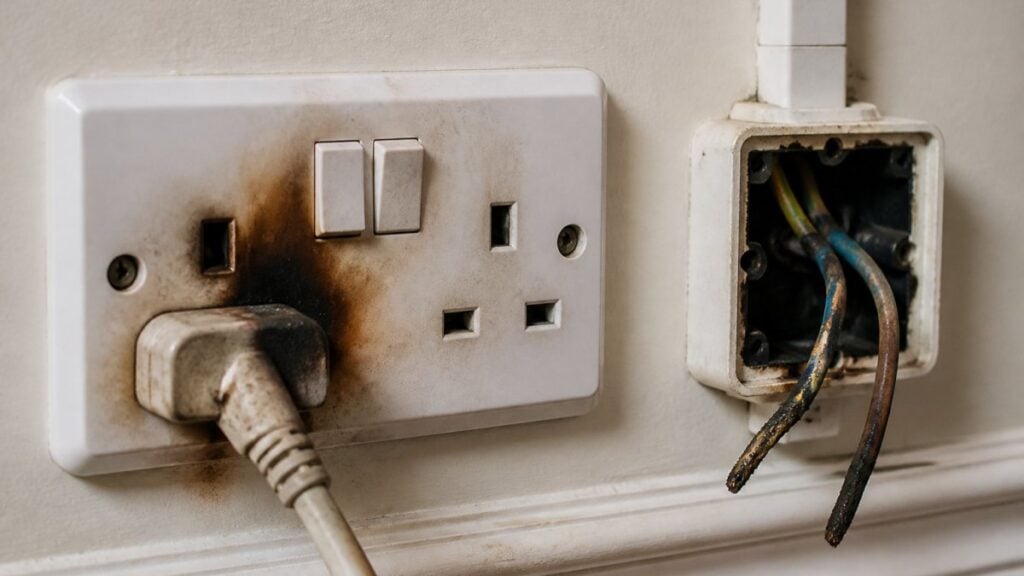
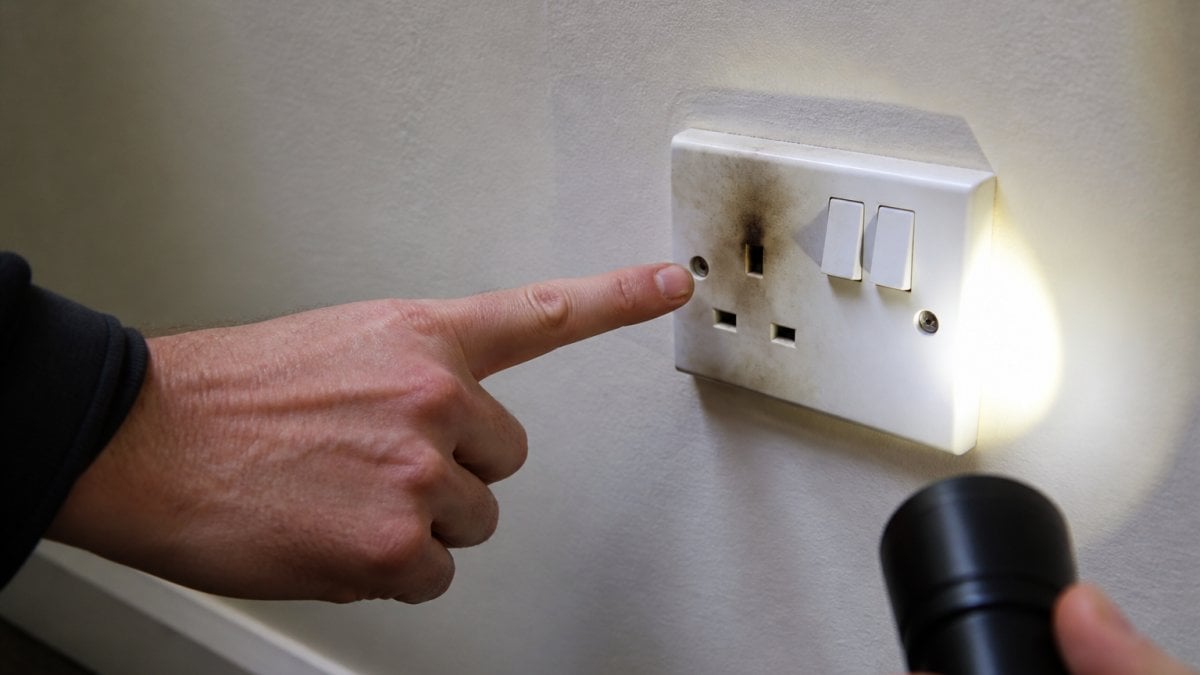
Brown discolouration around a socket, scorch marks on a switch plate, or a cracked faceplate all point to past overheating. Even if the socket still works, the damage is evidence of a fault.
Visible damage means the fitting needs replacing and the cause investigating. A new socket on top of a faulty circuit just hides the problem.
7. Frayed, Exposed or Damaged Wiring
Frayed wiring and exposed wires are common in older properties, especially where cables have been chewed by pests or damaged during DIY work. Any cable with cracked insulation or bare conductors is unsafe wiring and needs isolating.
Don’t touch exposed cables. Don’t tape them up as a permanent fix. Get them assessed.
8. Buzzing Sounds From Switches or the Consumer Unit
A faint hum from a dimmer switch can be normal.
Buzzing at the consumer unit often signals a failing breaker or a loose busbar connection. Both are electrical faults that need prompt attention.
Here are the eight warning signs, what each usually points to, and how urgently you should act.
| Warning sign | Likely cause | Urgency |
|---|---|---|
| Circuit breaker keeps tripping | Overloaded circuit, faulty appliance or loose connection | Book a prompt visit if it resets cleanly |
| Flickering or dimming lights | Loose connection or damaged wiring | Stop using the circuit if it buzzes |
| Burning smell near sockets or switches | Melting insulation or arcing connection | Emergency, isolate and call immediately |
| Sparking sockets and crackling sounds | Electrical arcing behind the socket face | Emergency, isolate and call immediately |
| Warm or hot sockets and switch plates | Loose connection or overloaded circuit | Book a fault finding visit |
| Discolouration, scorch marks or visible damage | Past overheating | Fitting needs replacing and cause investigating |
| Frayed, exposed or damaged wiring | Cracked insulation or bare conductors | Unsafe wiring, needs isolating and assessing |
| Buzzing from switches or consumer unit | Failing breaker or loose busbar connection | Emergency, isolate and call immediately |
When a Circuit Breaker Keeps Tripping: Fault or Normal?
A breaker that trips occasionally under heavy load is behaving normally. One that trips repeatedly, or with nothing unusual running, signals a fault. The difference comes down to pattern.
A modern consumer unit usually holds two types of protective device. An MCB (miniature circuit breaker) protects a single circuit against overload and short circuit. An RCD (residual current device), often an RCBO when combined with an MCB on one circuit, protects people from earth leakage, such as current escaping through damaged insulation or a faulty appliance.
Read the device before you reset it
- MCB tripped: the circuit has drawn too much current. Suspect an overloaded circuit (too many appliances on one ring) or a short circuit somewhere on the wiring.
- RCD or RCBO tripped: current is leaking to earth. Suspect damaged cable insulation, moisture ingress, or a faulty appliance. This is the more serious of the two and should not be ignored.
- Main switch tripped: the fault is upstream of the individual circuits. Stop and call an electrician.
The three-question test
Ask yourself:
- Does it trip only when specific appliances run together? That’s likely an overload. Move one appliance to a different circuit and see if the problem stops.
- Does it trip at random times, or overnight? Suspect a loose connection, damaged cable, or a faulty appliance that’s arcing intermittently.
- Does it trip immediately after you reset it, with nothing plugged in? That’s a hard fault on the wiring itself. Stop resetting it, repeated resetting into a dead short can damage the device and is a fire risk.
Never tape a breaker in the “on” position, never replace it with a higher-rated device, and never bypass an RCD. These devices are the only thing standing between a fault and a fire. If a breaker trips immediately every time you reset it, leave it off and call an electrician.
Normal behaviour versus a fault
Normal: a trip during a lightning storm, a trip when you plug in a known faulty appliance, or an RCD trip that resets cleanly and doesn’t recur.
If you’re unsure which you have, an electrician can test the circuit with insulation resistance and loop impedance testers and tell you in minutes, far cheaper than guessing.
UK-specific note on older installations
If your home still has a fuse box with rewirable fuses rather than a modern consumer unit with MCBs and RCDs, a tripping fuse is a blunter instrument, it gives you less information about the cause. In that case, treat every repeated trip as a prompt to book a periodic inspection (an EICR) rather than simply replacing the fuse wire.
Signs Your Home Needs Rewiring Rather Than a Repair
Sometimes a repair fixes everything. Sometimes the wiring has reached the end of its life and patching it up wastes money.
Your home likely needs rewiring if:
- The wiring dates from the 1970s or earlier and has never been updated
- You have rubber or fabric-insulated cables
- There’s no earthing in the sockets
A single faulty socket is a repair. Before committing to a rewire, see our guide to electrical rewiring costs to know what to expect. If you are weighing up a repair, our guide on whether it is time to change your fuse board can help you decide.
What to Do If You Suspect Faulty Wiring
Most guides stop at “call an electrician.” That’s the right end point, but it skips the minutes and hours before help arrives, when the real risk sits. Here’s the safe sequence, including what to record so the electrician works faster.
Step 1: Decide whether this is an emergency
Some signs mean stop everything and act now. Others give you time to book a visit.
Treat as an emergency, isolate and call immediately:
- A burning smell near a socket, switch, or consumer unit
- Visible flames, smoke, or scorch marks
- Sparking that continues with nothing plugged in
Book a prompt visit, usually within days, not hours:
- A breaker that trips repeatedly but resets cleanly
- A socket that feels warm with nothing plugged in
- Flickering lights in one room
Step 2: Isolate safely, but only if you can do so without touching anything damaged
If you can reach the consumer unit safely, switch off the affected circuit; if you can’t identify it, switch off the main switch. Do not touch a fitting that is sparking, scorched, or wet, and do not pull a plug from a socket that is smoking or crackling, switch the circuit off first.
Never touch exposed wires, never attempt to tape or twist damaged cables as a permanent fix, and never open a consumer unit yourself. The interior of a consumer unit remains live even when the main switch is off in some older installations. Only a qualified electrician should work inside it.
Step 3: Record what you saw, smelled, and heard
This is the step almost everyone skips, and it’s the one that saves the most time and money. Before you reset anything or call anyone, note:
- Which circuit tripped (the label on the consumer unit, or the room it serves)
- What was running at the time, appliances, heating, shower, anything
- Whether it recurred after resetting, and how quickly
An electrician arriving with this information can go straight to the likely cause.
Step 4: Keep everyone clear
Keep children and pets away from the affected area. Don’t use the affected socket or circuit for anything, not even a phone charger. If the consumer unit itself is buzzing, crackling, or hot, don’t stand near it and don’t attempt to open it.
Step 5: Call a qualified electrician and describe the pattern
When you call, lead with the pattern, not the symptom. “The kitchen ring trips every time the dishwasher runs” is more useful than “my electrics are faulty.” Mention whether the device was an MCB or an RCD, whether it reset, and whether there was any smell or heat.
If you’re worried about faulty wiring and want it properly investigated, our page on electrical fault finding in the home explains how a domestic visit works and what to expect.
Booking an Electrical Safety Inspection for a Home
An electrical safety inspection for a home checks the condition of your wiring, consumer unit, and circuits, and produces a written report on any faults found.
Homeowners often book one when buying a property or after a fault; landlords need one for rental compliance. Our guide on electrical safety inspections for homeowners and landlords explains when and why you need one.
The official guidance from GOV.UK on electrical safety in the home is worth reading if you want the government’s own advice on rented property checks.
Request a Wiring Assessment From MDS Electrical
Electrical faults rarely fix themselves, so it is worth having a concern checked rather than waiting. If any sign in this guide sounds familiar, have it looked at properly rather than hoped away.
At MDS Electrical, we have over 12 years of experience in domestic and commercial environments, and we are rated as one of the top three electricians in Peterborough. We are committed to reliability: appointments are kept and quotes are provided. Our tradesmen treat properties with respect, and we offer expert fault finding and fuse board upgrades.
We also provide professional certification and reporting for properties.
Request a quote from MDS Electrical today.
Frequently Asked Questions
How can I tell if my house wiring is faulty?
Look for a pattern rather than a one-off event. Repeated tripping, lights that flicker in one room only, warm socket faces, buzzing switches, scorch marks or a burning smell all point to faulty wiring. A single trip after using too many appliances is usually an overloaded circuit, not a fault. If two or more signs appear together, or any sign involves heat, smoke or burning, stop using the affected circuit and book an electrician.
Can faulty wiring cause lights to flicker or a circuit breaker to trip?
Yes, both are common symptoms. Loose connections, damaged insulation and overloaded circuits all interrupt current flow, which shows up as flickering or dimming lights. A breaker that keeps tripping is doing its job by cutting power to a fault; resetting it repeatedly without finding the cause is what turns a warning into a fire hazard. An electrician can test the circuit and identify whether the problem is a loose connection, a damaged cable or an appliance.
Is it safe to use a socket that feels warm?
No. A socket or switch plate that feels warm to the touch is overheating, usually because of a loose connection, an overloaded circuit or worn contacts inside the socket. Stop using it, switch the circuit off at the consumer unit if you can do so safely, and have it inspected. Visible heat damage, a burning odour or scorch marks mean you should call an electrician straight away rather than waiting.
Do signs of faulty wiring mean my house needs a full rewire?
Not always. One faulty socket or a single loose connection can often be repaired without touching the rest of the installation. A rewire becomes likely when wiring is decades old, uses outdated cable colours, has no earth continuity or shows damage across multiple circuits. An electrical safety inspection for a home, including insulation resistance testing, tells you which category you fall into before you commit to the cost of rewiring.