Table of Contents
- Why Commercial Electrical Maintenance Matters for Every Business
- What a Commercial Electrical Inspection Covers
- Your Commercial Electrical Maintenance Checklist
- Building an Electrical Maintenance Plan for Businesses
- How Often Should You Schedule Commercial Electrical Maintenance?
- How to Choose a Commercial Electrician
- The Risks of Neglecting Commercial Electrical Maintenance
- Conclusion
- Frequently Asked Questions
Last Updated: 18 October 2026
Why Commercial Electrical Maintenance Matters for Every Business
Commercial electrical maintenance is the planned inspection, testing and servicing of a business’s fixed wiring, distribution boards and electrical equipment to keep them safe, compliant and working. The electrical system is invisible until it fails, and by then the failure is expensive.
That is the core problem with how most organisations treat commercial electrical maintenance for businesses. A tripping circuit or a warm socket is treated as an inconvenience to be tolerated, not a warning to be acted on. Then a distribution board fails on a busy trading day and the cost is measured in lost takings, spoiled stock and staff sent home.
There is also a legal layer. The Electricity at Work Regulations 1989 require electrical systems to be maintained so far as is reasonably practicable to prevent danger, and the Health and Safety Executive’s guidance on electrical safety at work is clear that duty holders must be able to demonstrate maintenance has been carried out. “We didn’t know it needed doing” is not a defence.
Below, we break down what a proper inspection covers, what a maintenance plan should contain, how often to schedule work, and how to pick an electrician who will actually turn up.
What a Commercial Electrical Inspection Covers
A commercial electrical inspection is a structured assessment of the fixed installation, from the incoming supply through to the final circuits, and it produces a written report rather than a verbal “looks fine to me”.
The core document is the Electrical Installation Condition Report (EICR). It records the condition of wiring, earthing and bonding, distribution boards, protective devices and accessories, and it assigns observations a code from C1 (immediately dangerous) to C3 (improvement recommended). A satisfactory EICR is the evidence base for everything else in your maintenance programme.
Beyond the EICR, a full inspection typically covers:
- Distribution boards and consumer units, thermal checks, labelling, and whether protective devices match the circuits they serve
- Earthing and bonding, the single most common serious defect we find in older commercial premises
- Fixed equipment, heating, ventilation, kitchen and workshop circuits under load
- Portable appliance testing (PAT) where the business uses portable equipment, which is a separate regime from fixed-wire testing
- Emergency lighting and fire alarm supplies where these fall within the electrical scope
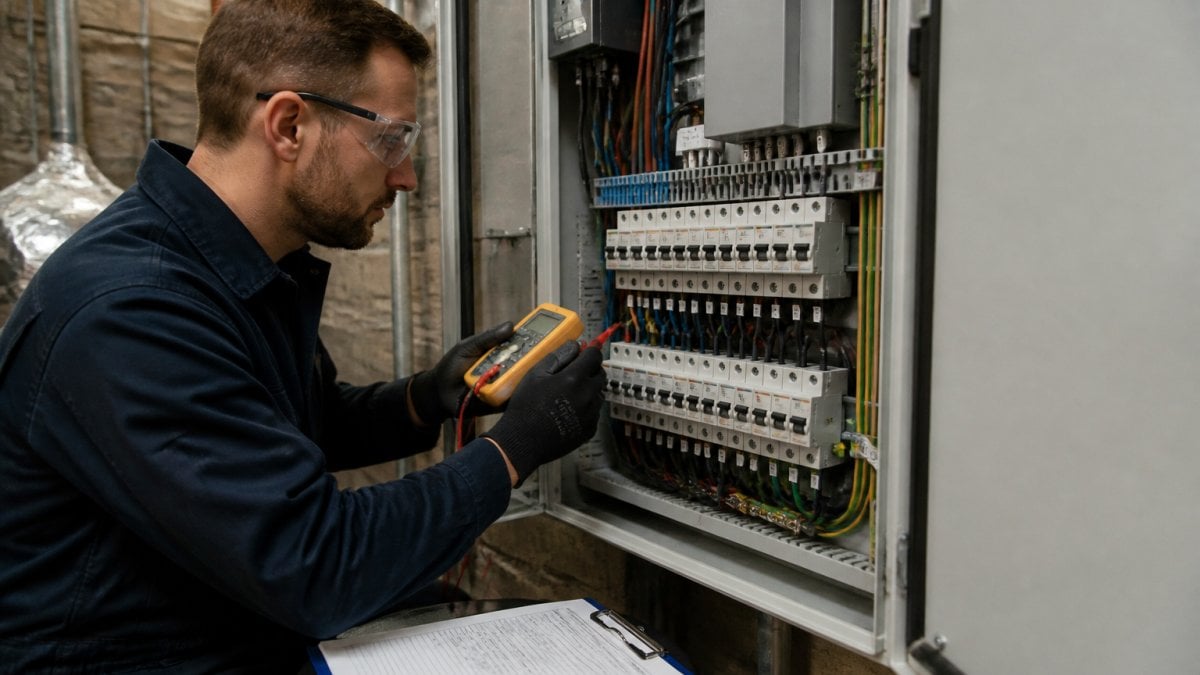
A C1 observation means the installation is dangerous and should be isolated immediately. If you receive an EICR with a C1 and do nothing, you are carrying the liability, not the electrician who wrote it.
Your Commercial Electrical Maintenance Checklist
A commercial electrical maintenance checklist is a recurring schedule of inspections, tests and physical checks that keeps the installation compliant between formal EICRs.
Use this as a starting framework and adapt it to your premises:
- Confirm the EICR is in date and all C1 and C2 observations are remedied
- Check distribution board labelling matches the circuits actually installed
- Visually inspect for scorching, discolouration or heat damage at accessories
- Test RCDs using the test button monthly and record the result
- Confirm emergency lighting operates on a simulated mains failure
- Review PAT records for portable equipment and re-test anything overdue
- Check earthing and bonding connections have not been disturbed by building works
- Log any circuit that trips repeatedly and get it investigated rather than reset
- Record all of the above with dates and who carried out the work
That last item matters more than most businesses realise. When an insurer or a health and safety inspector asks what you have done, a dated log is the answer. A memory of “the electrician looked at it last year” is not.
Building an Electrical Maintenance Plan for Businesses
An electrical maintenance plan for businesses is a written document that sets out what will be inspected, by whom, how often, and what happens when a defect is found. The plan is what turns a one-off EICR into a system.
We would build one in four parts. First, an asset register: every distribution board, circuit and significant piece of fixed equipment, with its location and age. Second, a risk rating for each asset based on how critical it is to trading and how heavily it is used. Third, a schedule, with high-risk assets inspected more frequently and low-risk ones on the statutory minimum. Fourth, a defect process that names who authorises remedial work and how quickly each code must be actioned.
The plan should also name a responsible person. In most small and medium businesses that is a facilities manager, an operations lead or the owner. The point is not the job title; it is that one named individual owns the schedule and the records.
Photograph every distribution board with its cover off during the first inspection and store the images with the asset register. When a circuit trips two years later, you have a visual baseline of what the board looked like when it was last certified.
How Often Should You Schedule Commercial Electrical Maintenance?
The statutory position is that maintenance must be carried out as often as needed to prevent danger, and the Electricity at Work Regulations 1989 do not set a single fixed interval for every premises. Frequency is driven by use, environment and the recommendations in your previous EICR.
In practice, the following intervals are a sensible starting point for most commercial premises:
| Frequency | Task | Typical premises |
|---|---|---|
| Monthly | RCD test button, visual check of boards | All |
| Quarterly | Emergency lighting flick test, PAT review | Retail, hospitality, offices |
| Annually | Emergency lighting full duration test, PAT where applicable | All |
| Every 3 years | Fixed installation inspection (EICR) | Offices, shops, low-risk |
| Every 5 years | Fixed installation inspection (EICR) | Industrial, high-use, older wiring |
| Change of occupancy | Full EICR before new tenant takes over | Rented commercial units |
Those intervals are guidance, not law. A premises with heavy plant, wet processes or a history of defects will need more frequent inspection, and the electrician carrying out the EICR can recommend a shorter cycle. Treat the previous report’s recommendation as the starting point for the next one.
How to Choose a Commercial Electrician
Choosing a commercial electrician comes down to three things: verifiable competence, evidence of similar work, and a track record of turning up. Everything else is marketing.
Start with registration. A competent commercial electrician should be a member of a government-approved competent person scheme, and you can check a contractor’s registration with the relevant scheme operator before appointing anyone. Ask for their public liability insurance certificate and confirm it covers commercial work, not just domestic.
Then ask for evidence. Not a list of services on a website, but two or three comparable commercial jobs with references you can contact. A firm that has maintained a similar premises will be able to describe the specific problems that type of building throws up.
Finally, test the responsiveness before you commit. Send a query and see how long a reply takes. Ask when they can attend a non-urgent call. A contractor who is slow to quote will be slower to attend when a board fails at 6pm on a Friday.
The cheapest quote is rarely the cheapest outcome. A contractor who undercuts on the inspection is often making the money back on remedial work, and you will not know which observations were genuine until someone else looks.
The Risks of Neglecting Commercial Electrical Maintenance
The risks of skipping commercial electrical maintenance fall into three buckets: safety, legal and financial. All three compound.
On safety, the failure modes are well understood. Deteriorating insulation, loose terminations and overloaded circuits generate heat, and heat starts fires. An installation that has never been inspected is an installation where nobody knows which of those conditions exist. The HSE’s electrical safety guidance is blunt about the duty to maintain, and enforcement action follows where a duty holder cannot show they took it seriously.
On legal exposure, the picture is straightforward. If an employee or a member of the public is injured by a defect that a routine inspection would have caught, the absence of a maintenance record becomes the central fact of the case. Insurers also ask for maintenance evidence when a fire claim is assessed, and a gap in the record can affect the claim.
On cost, neglect is expensive. A failing distribution board replaced in an emergency costs more than the same board replaced on a planned basis, and the downtime is unplanned. Repeated tripping that nobody investigates usually ends in a full circuit replacement rather than a single faulty accessory.
If your electrics trip when high-draw appliances run together, do not keep resetting the breaker. That pattern usually indicates an overloaded circuit or a failing protective device, and repeated resetting masks a fault that will not resolve itself.
Conclusion
The businesses that get electrical maintenance right are not the ones with the newest buildings. They are the ones with a dated record, a named responsible person and an electrician who answers the phone.
If your EICR is out of date, your distribution boards are unlabelled, or you have no maintenance record at all, that is the place to start. MDS Electrical has over 12 years of experience across domestic and commercial environments, and we provide written quotes, keep the appointments we make, and supply the certification and reporting your insurer and inspector will ask for. Request a quote.
Frequently Asked Questions
What does commercial electrical maintenance include?
It covers planned inspection and testing of distribution boards, circuits, earthing and protective devices, plus portable appliance testing, emergency lighting checks, thermal imaging and fault repairs. A commercial electrical maintenance schedule also records results so you can prove compliance. The exact scope depends on your premises, load and equipment, so a provider should tailor it after an initial survey rather than offer a fixed package.
How often should a business have its electrical systems inspected?
The interval depends on the type of premises and its use. The IET Wiring Regulations (BS 7671) set out recommended maximum periods, and your insurer or licensing authority may require shorter ones. High-risk sites such as workshops or kitchens are typically inspected more often than low-risk offices. A commercial electrical inspection should be booked to that schedule, with any remedial work logged and completed before the next cycle.
What should businesses check before hiring a commercial electrician?
Ask for proof they are a competent person, evidence of registration with a recognised competent person scheme, public liability insurance and recent commercial references. Confirm they will issue certificates for inspection and testing and that the quote itemises parts, labour and testing. Check response times for faults in writing, and ask who will actually attend site, because a named engineer matters more than a call centre promise.
Who is responsible for electrical safety in a commercial premises?
The duty holder, usually the business owner, director or facilities manager, is responsible for maintaining electrical systems safely. The Electricity at Work Regulations 1989 require systems to be constructed and maintained to prevent danger, and the Health and Safety at Work etc. Act 1974 places wider duties on employers. Keeping inspection records, acting on defects and using competent contractors are the practical ways to meet those duties.
How can businesses reduce electrical faults and downtime?
Book planned maintenance instead of waiting for failures, keep distribution boards labelled and clear, and act on thermal imaging findings before components fail. Portable appliance testing and emergency lighting checks catch problems early. A written electrical maintenance plan for businesses sets out who books tests, where records are kept and what happens when a fault is found, which shortens downtime and prevents repeat issues.
What are the signs that a commercial electrical system needs maintenance?
Frequent tripping, flickering lights, warm socket outlets, burning smells, buzzing distribution boards and discoloured faceplates all point to problems that need prompt attention. So does any history of shocks or intermittent power loss. These signs should trigger a commercial electrical inspection rather than a wait-and-see approach, because several of them indicate loose connections or overloaded circuits that can lead to fire.