Table of Contents
- EICR Certificate Requirements for Landlords: The Legal Basics
- EICR Inspection Requirements: What the Test Covers
- EICR Validity Period for Landlords: How Often to Test
- EICR Report Codes C1 C2 and C3: What They Mean
- EICR Remedial Work Deadline: Fixing Unsatisfactory Reports
- Your Compliance Checklist: Records, Tenants and Local Authorities
- Common Mistakes Landlords Make with EICR Certificates
- Frequently Asked Questions
Last Updated: October 21, 2026
EICR Certificate Requirements for Landlords: The Legal Basics
An EICR certificate is a formal document produced after an Electrical Installation Condition Report inspection, confirming whether a property’s fixed wiring is safe to use. Since 2020, landlords in the private rented sector have been legally required to obtain one before a new tenancy begins and to renew it at defined intervals. This guide sets out exactly what the rules demand, where landlords most often slip up, and how to stay compliant without wasting money on unnecessary remedial work.
The requirement sits within the Electrical Safety Standards in the Private Rented Sector (England) Regulations 2020, enforced by local authorities. They apply to most privately rented homes, including flats and houses let on assured shorthold tenancies. Failure to comply can result in a penalty notice of up to £30,000 per breach, and councils have powers to arrange remedial work themselves and recover the cost. The official guidance on electrical safety standards in the private rented sector sets out the full duties in plain terms.
Here is the part most landlords underestimate: the certificate itself is not the finish line. The obligations extend to serving copies on tenants, retaining records, and completing any remedial work within strict deadlines. Miss a step and the certificate you paid for does not protect you.
EICR Inspection Requirements: What the Test Covers
An EICR inspection is a detailed assessment of the fixed electrical installation, carried out by a competent person and covering everything from the consumer unit to the wiring accessories in each room. It is not a simple visual check. The electrician isolates circuits, tests insulation resistance, checks earthing and bonding, verifies polarity, and confirms protective devices operate correctly.
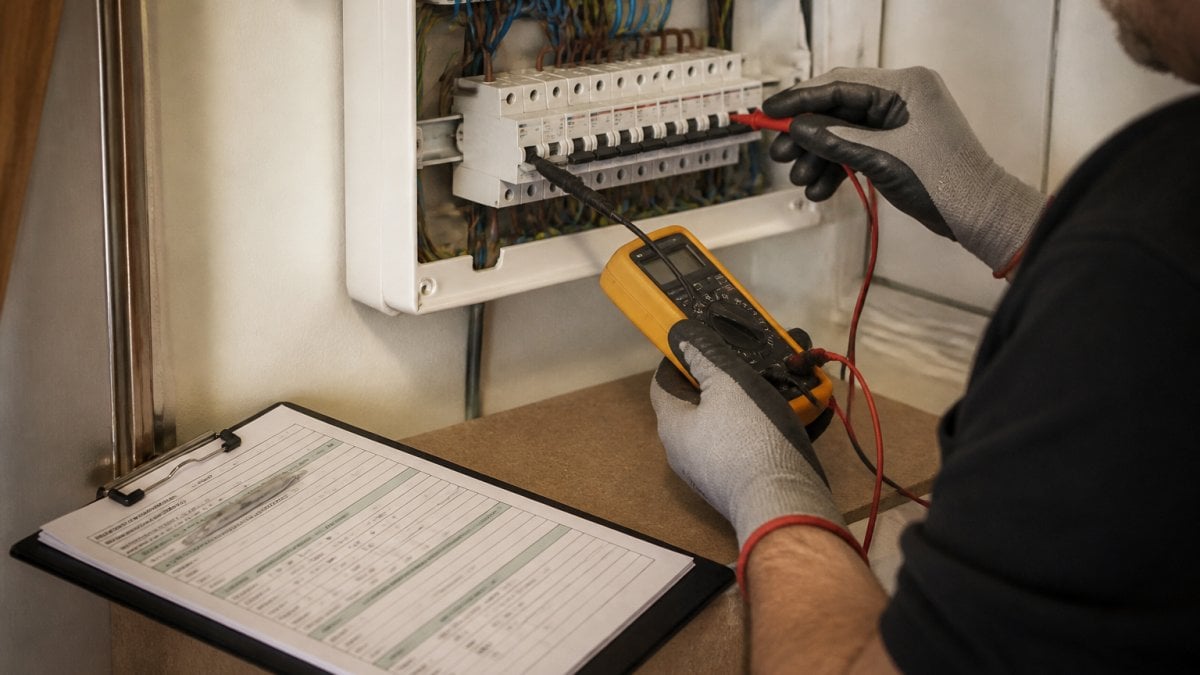
The inspection covers:
- The consumer unit and protective devices, including RCDs
- Earthing and main protective bonding arrangements
- Fixed wiring, sockets, switches, and light fittings
- Bathroom and kitchen circuits, which carry higher risk
- Any observable damage, deterioration, or non-compliant alterations
The output is a condition report with an overall assessment of satisfactory or unsatisfactory, plus coded observations. A common mistake is assuming a satisfactory report means the installation is modern. It does not. An older installation can be satisfactory if it is safe, even where it falls short of current standards for new work.
Ask your electrician to explain any observations marked for improvement before you receive the written report. Understanding the codes in advance saves a second visit and a second invoice.
EICR Validity Period for Landlords: How Often to Test
An EICR is valid for five years for most domestic rental properties, though the report itself may specify a shorter interval where the installation’s condition or age warrants it. The five-year period runs from the date of inspection, not the date you receive the document.
Two timing rules catch landlords out. First, a new certificate is needed before each new tenancy where one is not already in place and in date. Second, if the report recommends an earlier re-test, that recommendation overrides the standard five-year cycle. A property with ageing wiring may need inspection every three years or less.
For landlords managing multiple properties, a simple spreadsheet tracking inspection dates, report codes, and remedial deadlines prevents the scramble that comes with a tenant’s moving-in day. Set reminders ninety days before expiry, not thirty.
EICR Report Codes C1 C2 and C3: What They Mean
Every observation on an EICR carries a classification code, and the code determines both urgency and legal consequence. Understanding the difference between C1, C2, and C3 is essential because only two of them make a report unsatisfactory.
| Code | Meaning | Report Outcome | Action Required |
|---|---|---|---|
| C1 | Danger present, risk of injury | Unsatisfactory | Immediate action, isolate circuit |
| C2 | Potentially dangerous | Unsatisfactory | Remedial work within 28 days |
| C3 | Improvement recommended | Satisfactory | No legal deadline, plan for future work |
| FI | Further investigation needed | Unsatisfactory | Investigate, then reclassify |
A C1 finding means someone could be injured now. The electrician will typically isolate the affected circuit and may recommend the installation is not used until repaired. A C2 is a defect that could become dangerous under fault conditions. Both make the report unsatisfactory and trigger the remedial deadline.
C3 observations are the ones landlords misread. They do not make a report unsatisfactory and carry no statutory deadline, but ignoring a growing list of C3s is how a satisfactory report becomes an unsatisfactory one at the next inspection.
Treating a C3 as “nothing to worry about” is a false economy. C3 items often point to ageing components that will eventually fail, and the repair cost rises once a fault develops.
EICR Remedial Work Deadline: Fixing Unsatisfactory Reports
Where a report is unsatisfactory, remedial work must be completed within 28 days of the inspection date, or within whatever shorter period the report specifies (Electrical safety standards in the private and social rented sectors: guidance). This is the EICR remedial work deadline, and it is not negotiable.
The process has a fixed sequence:
- Receive the unsatisfactory report and note every C1, C2, and FI observation
- Arrange remedial work with a competent electrician
- Complete the work within 28 days
- Obtain written confirmation that the work is done and the installation is now satisfactory
- Serve the confirmation on the tenant and the local authority within 28 days of completing the work
That fifth step is where compliance quietly breaks down. Many landlords complete the repairs and file the paperwork without notifying anyone. The duty to supply written confirmation to the tenant and, where requested, the local authority, is a separate legal obligation. Keep proof of service, whether by email, hand delivery, or recorded post.
Your Compliance Checklist: Records, Tenants and Local Authorities
Compliance is a paperwork discipline as much as an electrical one. Use this checklist for every tenancy:
- Commission an EICR before a new tenancy starts, from a competent and qualified electrician
- Confirm the report is satisfactory, or note all coded observations
- Serve a copy of the report on the tenant before they occupy the property, or within 28 days of the inspection
- Serve a copy on the local authority within 7 days if they request it (Electrical safety standards in the private and social rented sectors: guidance)
- Complete remedial work within 28 days of an unsatisfactory report
- Obtain written confirmation of the remedial work
- Serve that confirmation on the tenant and local authority within 28 days
- Retain the report and confirmation for at least the duration of the tenancy and the following two years
- Diarise the re-test date, accounting for any shorter interval the report specifies
MDS Electrical carries out EICR inspections and remedial work for landlords across the local area, with appointment times kept and quotes provided up front.
Common Mistakes Landlords Make with EICR Certificates
The same errors appear again and again, and each one carries real financial exposure.
Using an unqualified inspector. A cheap report from someone without the right competence and insurance is worthless if challenged. Check qualifications and public liability cover before booking.
Missing the notification steps. Completing remedial work but failing to serve written confirmation on the tenant and local authority leaves you in breach despite spending the money.
Ignoring the report’s own interval. If the report recommends a re-test in three years, the five-year rule does not apply.
Assuming a satisfactory report covers appliances. The EICR covers fixed wiring and installations, not plug-in appliances. Separate duties apply to furnished appliances under the smoke and carbon monoxide alarm and furniture regulations.
Letting a C3 list grow. Small improvements deferred across two inspection cycles often become C2 findings, and by then the report is unsatisfactory and the 28-day clock is running.
The certificate is evidence. The compliance is the whole chain: inspection, report, remedial work, notification, and retention. Break any link and the chain fails.
Frequently Asked Questions
Is an EICR legally required for landlords?
Yes. Since 1 July 2020, landlords in England must have a valid EICR certificate for every rented property before a new tenancy begins. From 1 April 2021 this extended to all existing tenancies. The requirement is enforced by local authorities, and failing to comply can lead to a financial penalty of up to £30,000 per breach. You must also give a copy of the report to tenants and retain records.
How often do landlords need an EICR?
The EICR validity period for landlords is every five years, or sooner if the report states a shorter interval. A new report is also needed if the property changes tenancy and the previous certificate has expired. Some insurers or mortgage lenders may request more frequent inspections. Always check the ‘next inspection due’ date on your certificate and diarise it so you do not miss the renewal.
How long does a landlord have to fix an unsatisfactory EICR?
The EICR remedial work deadline is 28 days from the date of the inspection, or sooner if the report specifies. You must complete all code C1 and C2 remedial work within that window and obtain written confirmation from a qualified electrician that the work is done. Keep this evidence with the original report. If you fail to act, the local authority can serve a remedial notice and impose penalties.
Who needs to receive a copy of the EICR?
You must give a copy of the EICR to your existing tenants within 28 days of the inspection. For new tenancies, provide it before the tenant moves in. If the local authority requests a copy, you must supply it within seven days. Keep the original report and any remedial evidence for at least five years, or until the next inspection, so you can demonstrate compliance.
Can a landlord rent out a property with an unsatisfactory EICR?
No. If the EICR is unsatisfactory due to C1 or C2 codes, you cannot grant a new tenancy or continue an existing one until the remedial work is completed and verified. The only exception is if the report contains only C3 codes, which are advisory improvements and do not make the report unsatisfactory. Always resolve C1 and C2 issues before advertising the property.
What happens if a landlord does not have a valid EICR?
Without a valid EICR certificate, you risk a financial penalty of up to £30,000 from the local authority. You may also be unable to serve a valid section 21 notice to end a tenancy. Some insurers will void landlord insurance if electrical safety certificates are missing. If a tenant is injured due to faulty electrics, you could face prosecution under the Housing Act 2004 and the Electrical Safety Standards in the Private Rented Sector Regulations 2020.
Does an EICR cover appliances as well as fixed wiring?
No. An EICR inspection covers the fixed electrical installation only: wiring, sockets, consumer unit, earthing and bonding. It does not test portable appliances such as kettles, toasters or washing machines. For those, you need PAT testing, which is not a legal requirement for landlords in private rented homes but is recommended as good practice. Always check your tenancy agreement for any appliance testing clauses.
Landlord compliance is unforgiving of gaps, and electrical safety sits at the sharp end of it. If you need an EICR that is done properly, with clear reporting and remedial work completed on schedule, MDS Electrical can help. We bring over 12 years of domestic and commercial experience, professional certification and reporting for rental properties, and a record of turning up when we say we will. Request a quote from MDS Electrical and get your properties compliant without the chasing.